

Has your olive oil turned cloudy, or can you see flakes or solidified bits in it? Don't worry. This is a natural phenomenon that can occur when extra virgin olive oil is exposed to low temperatures for a longer period of time.
Olive oil doesn't have one exact solidification point. Depending on the oil's natural composition, crystals, flakes and cloudiness can already form at low temperatures. As it cools further, the oil can become increasingly thick and eventually partially or largely solidify.
This does not automatically mean there is anything wrong with the olive oil. Once the oil slowly returns to room temperature, the crystals usually disappear and the oil becomes liquid again.
How visible this effect is differs from one olive oil to another. Factors such as the olive variety, the time of harvest, the natural composition and the degree of filtration all play a role.
Solidified olive oil: is that a problem?
No. Olive oil partially or fully solidifying is not in itself a sign that the oil has gone bad or is of poor quality.
Extra virgin olive oil consists of various fatty acids, triglycerides, natural waxes and other components. These don't all have the same melting point. When the temperature drops, some components can therefore crystallise sooner than others.
As a result, the olive oil may first turn cloudy. Then small or larger flakes can form. As it cools further, an increasingly large part of the oil can solidify.
This process is reversible. As soon as the oil warms up again, the crystallised components melt and the olive oil becomes liquid again.
At what temperature does olive oil solidify?
There is no universal temperature at which all olive oil suddenly solidifies. Around minus 6 °C is sometimes mentioned as the solidification point of olive oil, but that is an oversimplification.
Extra virgin olive oil is a natural product and every oil has a different composition. The olive variety, the time of harvest, the fatty acid profile, natural waxes and the processing all influence how the oil behaves at low temperatures.
Some olive oils may already turn cloudy or partially crystallise at fridge-like temperatures. Other oils stay clear for longer at the same temperature. As the temperature drops further, the oil can become increasingly thick and eventually largely solidify.
So there is no single temperature at which all olive oil turns from liquid to solid.
Why do flakes form in olive oil?
The flakes you may see in cold olive oil can form because natural components of the oil crystallise at lower temperatures.
This can sometimes look a bit strange. The oil may appear cloudy or darker, and small or larger flakes may become visible. Especially when a bottle or tin is almost empty, changes in clarity and any natural particles can be more noticeable.
When this happens after exposure to cold, it does not automatically mean there is anything wrong with the olive oil.
Not sure about what you're seeing? Feel free to send us a clear photo. Our team is happy to take a look with you.
Does filtration affect cloudiness and solidification?
Yes. The way extra virgin olive oil is filtered can influence how many natural suspended particles, sediment and moisture remain in the oil after production.
Yakelos extra virgin olive oil is filtered. During the filtration process, the olive oil is passed through special filter plates. These remove, among other things, fine suspended particles and small amounts of residual moisture from the oil.

This photo shows the filter plates used during the filtration of our extra virgin olive oil.
The filtration installation can be adjusted to the desired degree of filtration. Depending on how intensively the oil is filtered, more or fewer fine particles can be removed from the olive oil. The more thorough the filtration, the more suspended microparticles and residual moisture can be removed from the oil.
Why do we filter Yakelos olive oil?
Filtration isn't just about making the olive oil look nice and clear.
By removing fine solid particles and residual moisture, the oil becomes more stable during storage. Good filtration can therefore help preserve the original quality of the extra virgin olive oil for longer.
The International Olive Council recommends filtration in part to remove suspended water and solid microparticles. During long-term storage, these components can promote processes that cause the oil's quality to deteriorate more quickly.
Filtration therefore has several benefits:
- the olive oil becomes clearer;
- less sediment forms;
- the amount of suspended particles is reduced;
- good filtration contributes to the stability of the oil during storage.
That's why at Yakelos we deliberately choose filtered extra virgin olive oil.
Does more filtration automatically mean a longer shelf life?
More thorough filtration can contribute to better stability and thereby help protect the quality better throughout the shelf life. This is mainly because more residual moisture and fine solid particles are removed from the oil.
But filtration is not the only factor that determines the final shelf life. The quality of the olives, the time of harvest, the processing, the amount of oxygen, exposure to light, storage temperature and packaging are important too.
More filtration therefore doesn't automatically mean that every oil will keep for an exact number of extra months. It is one of the factors with which we can improve the quality and stability of olive oil during storage.
But filtered olive oil can solidify too
This is an important distinction: filtration and solidification are not the same process.
Filtration mainly removes moisture and fine solid particles. The natural fats and other components that olive oil itself consists of naturally remain. That's why even well-filtered extra virgin olive oil can turn cloudy, thicken or form crystals and flakes at low temperatures.
The fact that Yakelos olive oil is filtered therefore doesn't mean the oil can never solidify in the cold. Filtration can reduce visible particles and sediment, but it does not fully prevent the natural crystallisation of the oil caused by low temperatures.
Quick tip: how to make the flakes disappear
Want to check whether the flakes were caused by the cold?
- Pour a small amount of olive oil into a glass bottle or glass jar.
- Hold the glass under a warm, but not hot, tap.
- The gradual warmth melts the crystallised components again. You'll often see the cloudiness and flakes vanish like snow in the sun.
Don't use boiling water and don't heat the olive oil more than necessary. Gentle warming is enough.
You can of course also simply let the oil come to room temperature. That takes a little longer, but if the flakes were caused by the cold, they will usually disappear on their own.
Does solidification affect the quality?
Temporarily solidifying or turning cloudy due to low temperatures does not in itself have a negative effect on the quality of the olive oil. Far more important for the shelf life of extra virgin olive oil are oxygen, light and prolonged exposure to heat.
- Oxygen can accelerate oxidation as soon as the oil comes into contact with it.
- Light can affect natural antioxidants and speed up the ageing process.
- Heat can, with prolonged exposure, cause the quality and flavour of olive oil to deteriorate more quickly.
That's why we recommend storing olive oil in a cool, dark place and well sealed. A dark kitchen cupboard, away from the stove and direct sunlight, is an excellent spot for most households.
Why does Yakelos use dark bottles and tins?
Good extra virgin olive oil deserves protection from light. That's why at Yakelos we use packaging that protects the olive oil as well as possible. Our dark bottles and metal tins limit exposure to light.
A clear bottle that stands in bright light for a long time offers considerably less protection.
After opening, always keep the packaging well sealed to limit contact with oxygen as much as possible.
Is solidified olive oil proof that it's real olive oil?
No. It is sometimes claimed online that you can test the authenticity or quality of olive oil by putting it in the fridge. If the oil solidifies, it would be real olive oil. If it stays liquid, something would be wrong with it.
It doesn't work that simply. Different authentic extra virgin olive oils can behave differently at exactly the same temperature. This is due to differences in, among other things, the olive variety, the time of harvest, the fatty acid profile, natural waxes and the way the oil was processed and filtered.
The fridge test is therefore not a reliable way to determine the authenticity or quality of olive oil.
When should you contact us?
Cloudiness, crystals and flakes after exposure to low temperatures can be normal.
But do you see something you don't trust, such as unusual dark or black particles? Or does the oil smell or taste noticeably different from what you're used to? Then, to be on the safe side, don't just continue using it.
Take a few clear photos and get in touch with us. We're happy to take a look and can assess whether it's most likely natural crystallisation or whether further investigation is needed.
How to store olive oil best
- Preferably store extra virgin olive oil in a dark place at a fairly constant temperature.
- Avoid direct sunlight and don't place the oil next to a stove, oven, radiator or other heat source.
- Always close the bottle or tin properly after use.
A dark kitchen cupboard is a great spot for most households.
From olive to bottle: protecting quality
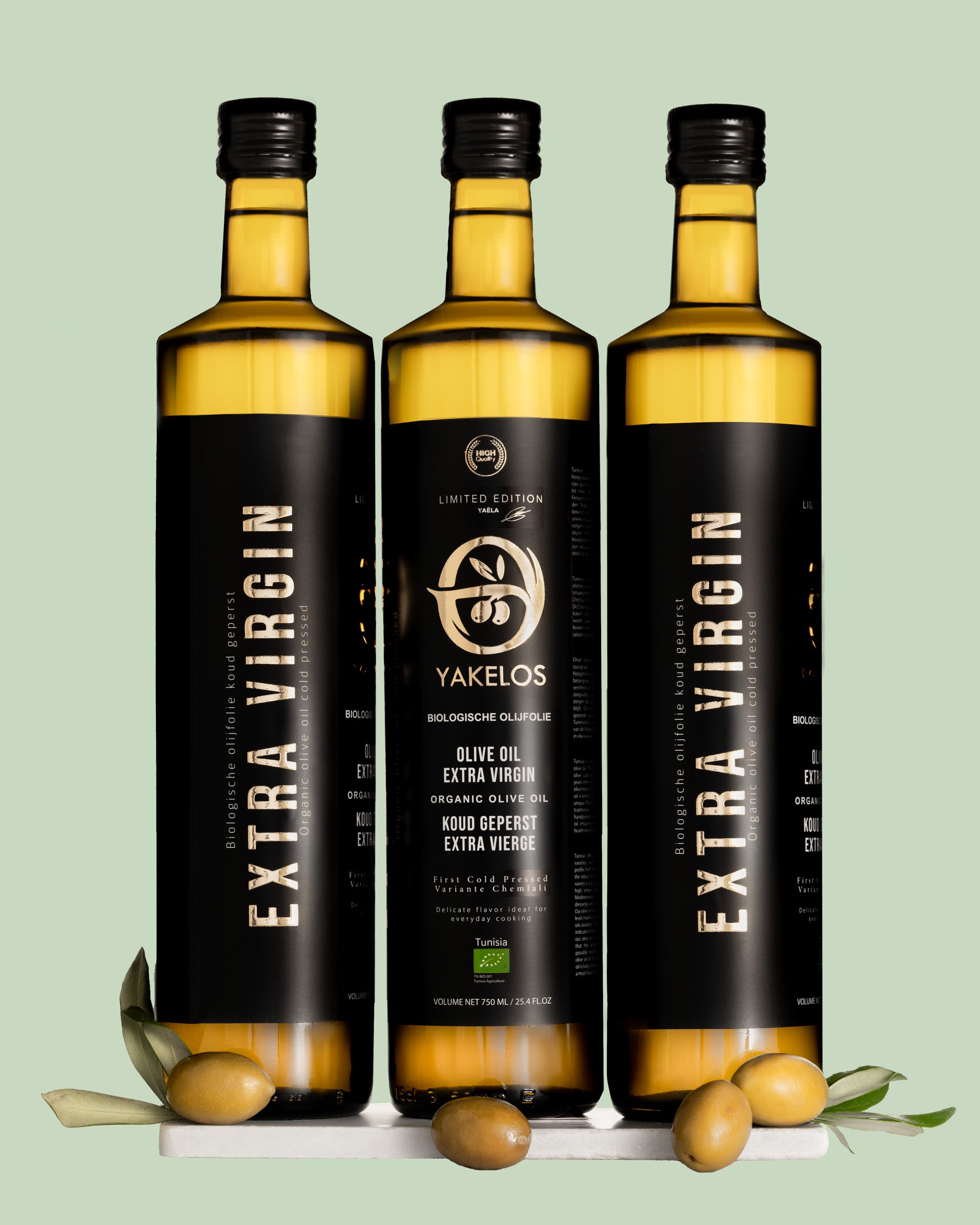
At Yakelos, we don't just look at how an olive oil tastes at the moment it's produced. We also want to protect that quality as well as possible until you use the oil at home. That's why our organic extra virgin olive oil is carefully processed, filtered and packaged.
Filtration helps remove residual moisture and fine particles. Our dark bottles and tins then protect the oil from light. Well-sealed packaging helps limit contact with oxygen.
Do you still notice cloudiness or flakes during a cold spell? That doesn't have to mean anything is wrong with the oil at all. Let the olive oil slowly come to room temperature, or try our simple test with a small amount of oil in a glass bottle or jar under warm water. You'll often see the flakes vanish like snow in the sun.
Curious about Yakelos organic extra virgin olive oil? Browse our range and taste the difference for yourself.